
Do The Math
Ballot measure GG says that revenues from the transfer tax increase will go towards essential services and infrastructure.
“Shall the measure, providing funding for City of Piedmont’s essential city services, such as police, fire, and emergency medical response; and maintenance of aging City buildings, parks, stormwater drains, roads and sidewalks, by increasing the real estate transfer tax from 1.3% to 1.75% to be more in line with neighboring cities and to generate approximately $1,500,000 annually in general tax revenue until ended by voters, be adopted?”
That’s a bit of a stretch. The Municipal Services Special Tax (the parcel tax) raised $3.7M last year and it and the General Fund are the primary revenue for essential services. The Real Property Transfer Tax (RPTT) is mainly used for capital projects and maintenance. As the BAFPC noted in its recommendation to raise the RPTT:
“In recent years, the City has spent $3M to $6M annually for facilities maintenance and capital improvements. This range excludes unplanned expenditure related to the new Community Pool, which should be viewed as a one-time item. RPTT revenues, including the proposed increase [$1.5M], will allow the City to maintain its current capital spending level and better address rising capital and maintenance costs.”
BAFPC, May, 2026
Specifically, GG proposes to raise the tax from 1.3 to 1.75% in order to raise annual revenue of $6.2M, again for capital spending and maintenance. As the figure below shows, Piedmont’s transfer tax revenue has steadily grown over the past 25 years to almost $5M this year and is estimated to reach $5.6M by 2030.
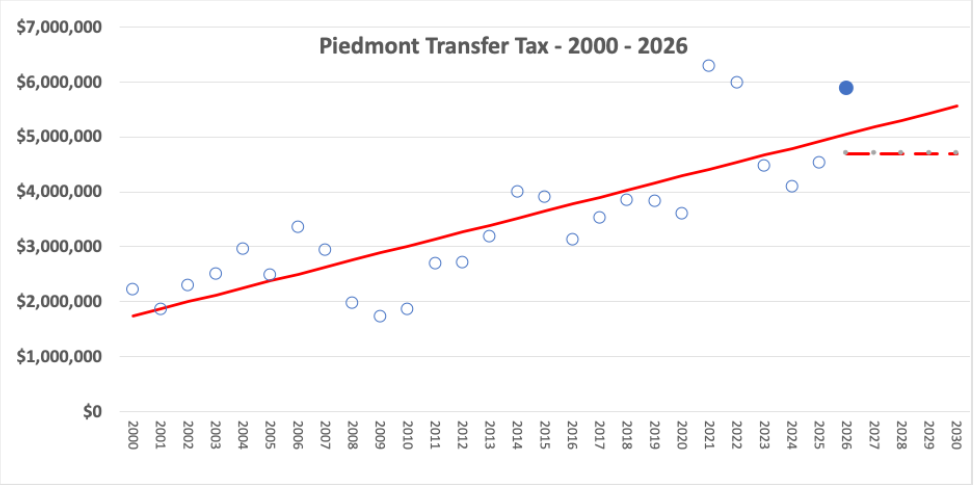
Dashed line represents flat 5-year growth used to estimate GG tax increase. Solid point represents 2026 RPTT tax revenue.
Unfortunately, the BAFPC did not account for this revenue growth when proposing the tax increase, resulting in an unnecessary tax burden to achieve its stated objective. If the City needs $6.2M a year for capital/maintenance, it will get there through the steady growth of Piedmont home values or with a more modest increase in the transfer tax. As the table below shows, estimated growth in Piedmont homes values over the next 4 years will raise nearly 86% of the additional funding the city needs. Assuming this growth, if the transfer tax were raised to just 1.5%, the City will achieve the necessary funding. At 1.75% and expected growth, the City will raise $29M.
| Annual Revenue at Different Tax rates assuming flat and current growth. | ||||
| *GG at 1.75% | Current at 1.3% | Current at 1.5% | Current at 1.75% | |
| Y1 | 6.2 | 5.2 | 6.0 | 7.0 |
| Y2 | 6.2 | 5.3 | 6.2 | 7.2 |
| Y3 | 6.2 | 5.5 | 6.3 | 7.4 |
| Y4 | 6.2 | 5.6 | 6.5 | 7.5 |
| Revenue (M) | 24.8 | 21.5 | 25.0 | 29.1 |
*GG assumes transfer tax revenue will be flat at $4.7M over the next 4 years.
Recall that this tax is not distributed evenly over Piedmont’s 4000 homes but the approximately 125 who sell and buy homes every year. Should capital improvements and maintenance be funded by those coming and going from Piedmont? As the City likes to say, voters should “do the math” and decide if GG is necessary.
Addendum: City RPTT revenue for 2025-26 was $5.9M and the analysis accordingly adjusted.